A dimmer that behaved perfectly with halogen lamps can turn awkward the moment you fit LEDs. The signs are usually the same: a shimmer at low levels, an audible buzz, a dimming range that jumps from full brightness to off, or a flicker that comes and goes. It rarely means the bulbs are faulty. Almost every time it comes down to three things — the type of dimmer, the load it expects to see, and whether the lamp or driver was built to be dimmed at all.
Dimming is a conversation, and both sides have to agree
An incandescent or halogen lamp is a simple resistive load: give it less power and it glows less. The dimmer chops the mains waveform and the filament absorbs whatever it is given. LEDs don't work that way. The chip needs a driver to convert mains voltage into the constant current it wants, and that driver has to interpret what the dimmer is doing. Pair the two badly and the driver misreads the chopped waveform — which is exactly the flicker you're seeing. It isn't a fault as such. It's a disagreement between two pieces of electronics.
Check one: is the lamp or driver actually dimmable?
Start with the simplest question. Plenty of LED lamps sold as "dimmable" carry a caveat in the small print: dimmable with selected dimmers, or dimmable with trailing-edge dimmers. Others are plainly marked non-dimmable. A non-dimmable lamp on a dimmer circuit will flicker, buzz or fail early, and no amount of tinkering will settle it.
On the packaging, look for wording such as mains dimmable, trailing-edge compatible or TRIAC dimmable, and note any recommended dimmer list. With integrated LED fittings and LED strip, the lamp isn't the thing to check — the driver is. A driver labelled 0-10V, DALI or PWM will not work with a standard wall dimmer, however good that dimmer is. You need a mains-dimmable driver matched to the dimmer's specification. As a rule, buy every lamp on a circuit as the same make and model; mixing brands and wattages on one dimmer reliably creates odd behaviour at the bottom of the range.
Check two: the minimum load trap
Older dimmers were designed around lamps that drew real power. A dimmer from the halogen era might need 40W or 60W on the circuit to regulate properly, and some units quote a minimum as low as 20W. Modern LED lamps draw a fraction of that. Six 4W lamps total 24W, and a dimmer expecting 40W simply cannot control that load. The symptoms are consistent:
- flicker or shimmer, especially at low brightness
- buzzing or humming from the switch itself
- lamps dropping out, or refusing to light at low settings
- a faint glow when the dimmer is off, often called ghosting
- a range that goes from full brightness to nothing with no middle
Do the sums before you buy anything. Add up the actual wattage of every lamp on that dimmer — a 10W LED replacing a 60W halogen still counts as 10W — and compare the total with the minimum and maximum figures printed on the dimmer. If the total sits below the minimum, you have three routes: add a compatible load module, fit a dimmer rated for low-wattage LED loads, or put the LEDs on a plain switch and dim them another way. Check the maximum too. Dimmers are often derated when several are packed into one multi-gang plate, because there is less air around them to shed heat.
Check three: leading-edge or trailing-edge?
This is the part most people miss, and it is usually the fix. A leading-edge dimmer (also called TRIAC, or a standard dimmer) switches the mains on part-way through each half-cycle. It was built for resistive and inductive loads, and it is cheap and robust, which is why it ended up in so many homes. A trailing-edge dimmer switches off part-way through instead. That gentler cut suits capacitive electronic loads such as LED drivers, so the lamp behaves more predictably and the buzz largely disappears.
There is a second problem with older switches: a dimmer with no neutral connection powers its own electronics by leaking a small current through the lamp. With a tiny load, that leakage can leave the lamp faintly lit or flickering when it should be off. Fitting a trailing-edge dimmer module designed for LED loads — or a smart dimmer module specified for low-wattage LED — resolves more flicker complaints than everything else here combined. Note that many trailing-edge dimmers need a neutral at the switch position, so check the box before you buy.
If the dimmer is right, rule out the rest
- Loose connections. A slack terminal in the switch or at the lamp holder creates flicker that comes and goes with heat or vibration.
- Mixed lamp types on one circuit, including one stray halogen left in a downlight, which changes both the total load and the dimming curve.
- Heat. A dimmer buried in insulation, or overloaded in a gang plate, can cut in and out as it warms.
- A failing driver. If one fitting in a group flickers and the rest are fine, swap the lamps round to see whether the problem follows the lamp or stays with the fitting.
- Voltage dips from a heavy appliance on the same circuit. Rare, but noticeable if the flicker matches the kettle or the shower switching on.
Fixes, cheapest first
- Confirm every lamp and driver is dimmable, and use one make and model throughout.
- Do the wattage maths and check the dimmer's stated minimum and maximum.
- Set the minimum trim if the dimmer has one. Many trailing-edge modules have a small screw or dial for this; it stops the lamp dropping out at the bottom of its range.
- Replace the dimmer with a trailing-edge unit rated for LED loads, adding a neutral connection if the module needs one.
- Add a load or bypass module if the total wattage stays stubbornly low. Follow the manufacturer's instructions, and be aware these dissipate a little heat.
- For low-voltage or integrated fittings, change the driver to a mains-dimmable one specified as compatible with your dimmer.
- If nothing settles it, run the circuit on a normal switch and dim with smart lamps or a dedicated LED dimming kit instead.
When to call an electrician
Before you touch anything, isolate the circuit at the consumer unit and satisfy yourself that it is dead — a two-way switch or a borrowed neutral can still catch you out. If you are not confident, stop there. That is a perfectly sensible decision, not a failure.
Call a registered electrician if the dimmer gets hot, if the wiring looks old or there is no earth at the switch, if a neutral is required at the switch position and there isn't one, or if flicker continues after you have fitted a matching dimmer and known-good lamps. Persistent flicker is also worth resolving rather than living with if anyone in the house is sensitive to flickering light, so take proper advice if that applies. And if you are unsure whether the work counts as notifiable, just ask — a registered electrician will answer in one sentence.
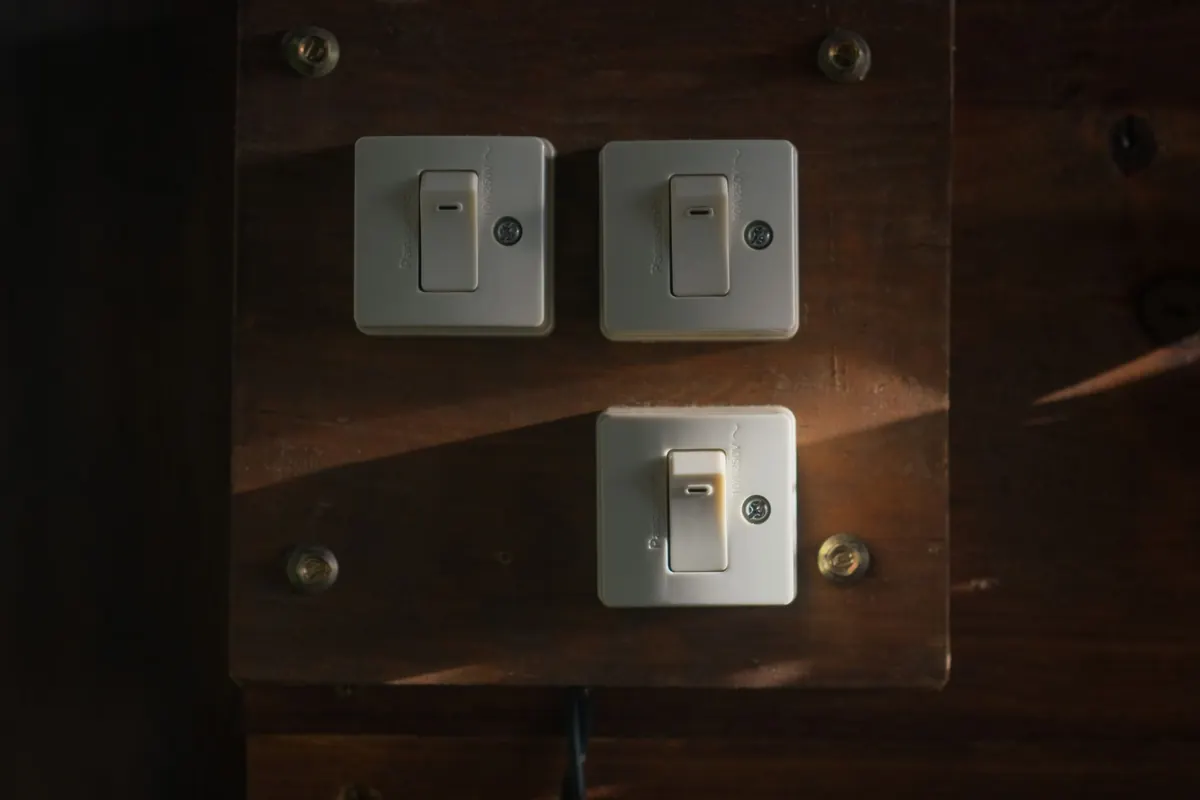
Photo: Dương Nhân / Pexels